All-on-4 Dental Implants Cost: Full-Arch Pricing Guide
If you are losing most or all of your teeth in one arch, one treatment name keeps coming up: All-on-4. It promises a full set of fixed teeth on just four implants, often with temporary teeth the same day. The next question is always the same. What is the all on 4 dental implants cost in 2026, and why do quotes swing from $15,000 to more than $35,000 per arch?
This guide answers both questions in plain language. You will see typical US price ranges per arch and for both arches, what an All-on-4 quote usually covers and what gets billed separately, how All-on-4 compares with All-on-6 and individual implants, the factors that move the price up or down, and how patients actually pay for it. For single-tooth figures, see our single tooth pricing guide instead. This one stays focused on full arches.
Quick answer: In the United States in 2026, All-on-4 typically costs $15,000 to $35,000 per arch, with most quotes landing between $20,000 and $30,000. Both arches usually run $30,000 to $90,000. The final price depends on the prosthetic material, whether you need extractions or grafting, the type of sedation, and where you live.
What Is All-on-4, Exactly?
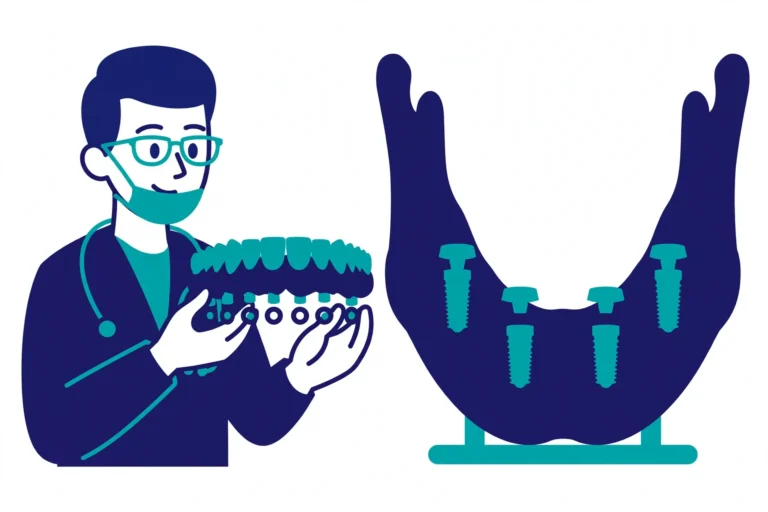
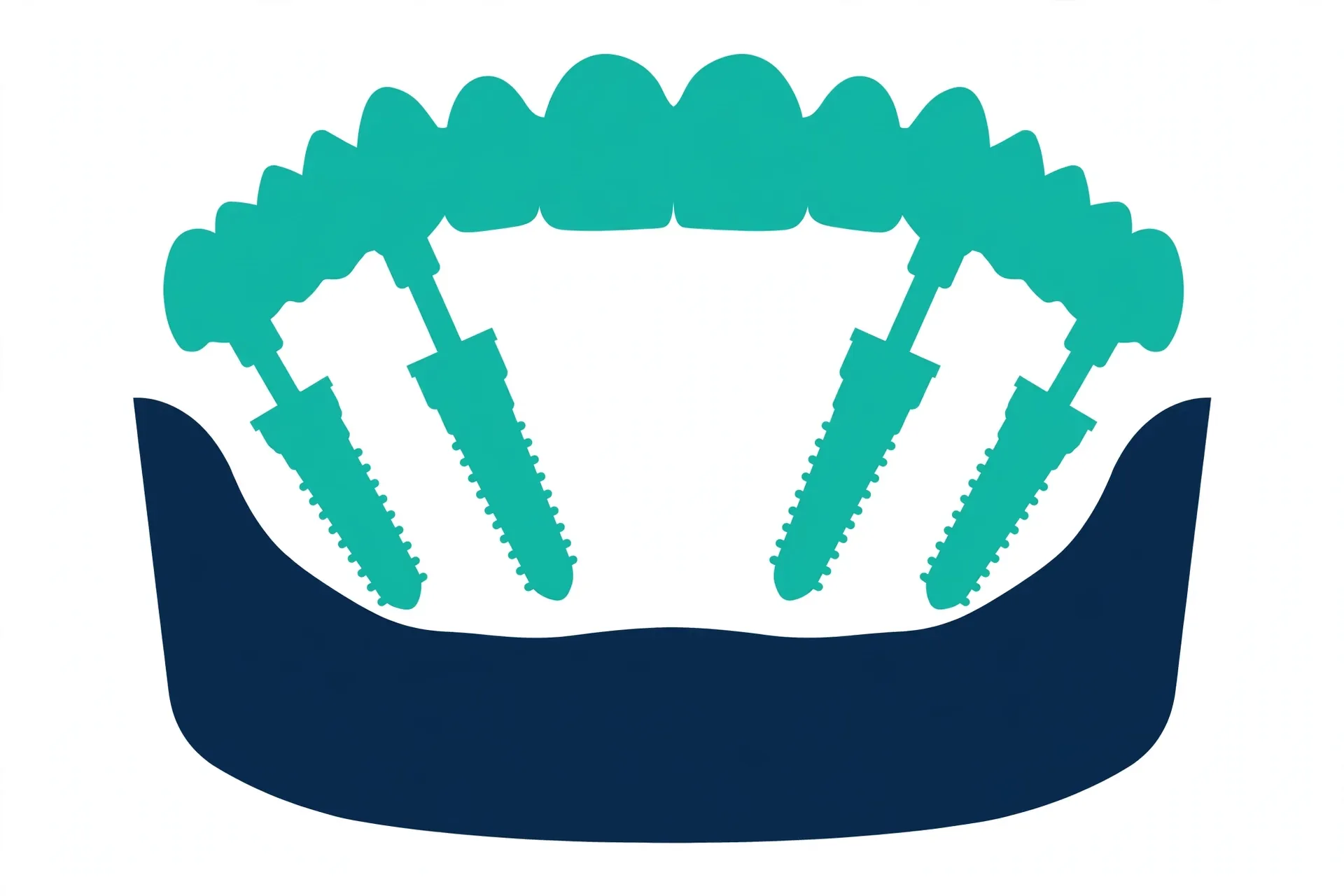
All-on-4 is a full-arch tooth replacement method. Four dental implants are placed in the upper or lower jaw, and a complete set of fixed replacement teeth is attached to them. The two back implants are tilted at an angle, which lets them sit in areas where bone is naturally thicker. That design is why many patients can skip bone grafting.
You do not get individual implants for each missing tooth. Instead, one full-arch prosthesis (a fixed bridge made to look like a row of natural teeth) rests on the four implants. Most patients leave surgery day wearing a fixed temporary set, then receive the final bridge after the implants fuse with the bone, usually 3 to 6 months later. If you want the broader basics first, read what dental implants are before you book a consultation.
All-on-4 is best for people who have lost most teeth in an arch or whose remaining teeth are failing and will need to come out. If only one or two teeth are missing, individual implants are usually the better and cheaper fit. Dentists may also suggest All-on-4 over traditional dentures for patients who want teeth that do not come out at night and who can chew with far more confidence.
All-on-4 Cost in 2026: US Price Ranges
US clinics quote All-on-4 by arch (upper or lower), not by implant. The typical 2026 range per arch is $15,000 to $35,000, with most full-service quotes falling between $20,000 and $30,000. Both arches combined generally run $30,000 to $90,000. Premium clinics using a full zirconia final bridge may quote $35,000 or more per arch, while budget chains sometimes advertise teaser prices near the low end that cover only part of the treatment.
It helps to see where the money goes. A per-arch quote roughly splits into two halves: the surgery (implants, abutments, anesthesia, planning) and the prosthesis (the temporary and final teeth, plus the lab work to make them). The table below shows typical component ranges from US providers in 2026.
| Component | Typical US range (per arch) | Notes |
|---|---|---|
| Four implants and abutments | $10,000 – $15,000 | Surgery, placement hardware, and the connectors the teeth attach to |
| Temporary fixed teeth (same day) | Included in most quotes | Usually a resin or acrylic bridge worn during healing |
| Final prosthesis (acrylic hybrid) | $10,000 – $15,000 | The standard final set: acrylic teeth on a metal framework |
| Final prosthesis (zirconia upgrade) | $15,000 – $25,000 | Stronger ceramic teeth; often quoted as an upgrade tier |
| Consultation, CBCT scan, planning | $0 – $500 | Many clinics bundle this free; some charge separately |
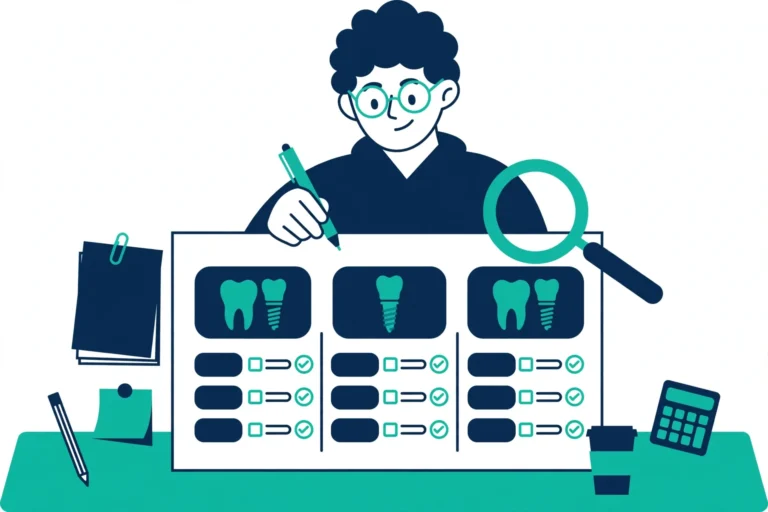
One important habit: always compare all-in totals, not the first number on a flyer. A $15,000 ad that covers only the implants is more expensive than a $22,000 quote that includes the final teeth. Ask every provider for a written, itemized quote so you can compare like with like.
What an All-on-4 Quote Usually Includes (and What Costs Extra)
All-on-4 pricing causes confusion because quotes are not standardized. One clinic’s “all-inclusive” price can mean something very different from another’s. The table below separates the items most US quotes include from the items that are commonly billed on top.
| Usually included | Often billed separately |
|---|---|
| Initial consultation and treatment planning | Tooth extractions (per tooth, if needed) |
| 3D CBCT scan and digital planning | Bone grafting or sinus lift |
| Four implants and abutments | IV sedation or general anesthesia upgrade |
| Local anesthesia during surgery | Zirconia final bridge upgrade |
| Fixed temporary teeth on surgery day | Night guard for grinders |
| Final fixed prosthesis (standard material) | Long-term maintenance visits after year one |
| Follow-up visits during the healing months | Travel, lodging, and time off work |
Extractions deserve special attention. Many All-on-4 patients still have failing teeth that must come out first, and extraction fees can add hundreds to thousands of dollars per arch. Bone grafting is less common with All-on-4 than with other full-arch methods, but some patients still need it, especially in the upper jaw near the sinuses. And sedation pricing varies widely: local anesthesia is standard, while IV sedation can add $500 to $1,500 or more. Get every extra priced in writing before surgery day, not after.
All-on-4 vs All-on-6 vs Individual Implants
All-on-4 is not the only full-arch option, and the alternatives explain why quotes differ. Here is how the main approaches compare in the US in 2026.
| Approach | Implants per arch | Typical per-arch cost | Fixed or removable | Often needs grafting? |
|---|---|---|---|---|
| All-on-4 | 4 | $15,000 – $35,000 | Fixed | Rarely |
| All-on-6 | 6 | $24,000 – $38,000 | Fixed | Sometimes |
| Individual implants with crowns | 8 – 10 | $40,000 – $90,000+ | Fixed | Often |
| Snap-on implant denture (overdenture) | 2 – 4 | $8,000 – $14,000 | Removable | Rarely |
All-on-6 adds two implants to the same concept. It typically costs $2,000 to $6,000 more per arch than All-on-4. Dentists recommend it for patients with strong bite forces, teeth grinding, or enough bone to make the extra implants worthwhile. For most patients with moderate bite forces, clinical studies show All-on-4 performs similarly at a lower cost and with less surgery.
Individual implants (one implant per tooth, or nearly) give the most natural result but cost the most by far. Treating a full arch this way can double the price of All-on-4, take 6 to 18 months, and usually requires grafting. Patients choose it when budget is secondary and they want each tooth to stand alone.
Snap-on dentures sit at the other end. Two to four implants anchor a removable denture that clicks in and out. It costs far less than any fixed option, but it comes out at night and covers the palate or gums differently. It is a real alternative for budget-driven patients who can accept removable teeth.
What Drives the Price Up or Down
Two patients can get All-on-4 from the same clinic and pay very different totals. These are the five factors that move the number most.
1. Prosthetic material
The single biggest price lever is what your final teeth are made of. The standard option is an acrylic or composite hybrid: acrylic teeth on a titanium or metal bar. It looks good and costs the least, but it wears faster and usually needs replacement or rework after 5 to 10 years. Zirconia is a dense ceramic that resists staining and chipping far better, and it can last much longer, but it typically adds $5,000 to $10,000 or more per arch. Ask how long each material is expected to last under your clinic’s warranty, and divide the quote by those years. The “expensive” option is often cheaper per year of use.
2. Extractions and grafting
Remaining teeth that must come out are billed per tooth or per arch, and the bill can surprise patients who assumed surgery day covered everything. Bone grafting adds more. All-on-4’s angled implants avoid grafting for many patients, which is one reason it stays cheaper than older full-arch methods, but it is not a guarantee. A CBCT scan shows your bone volume before any quote is final, so treat an early phone estimate as a starting point, not a price lock.
3. Sedation level
Local anesthesia is included in almost every quote. Conscious oral sedation is a modest step up. IV sedation, where you sleep through the procedure under monitoring, is the most comfortable and the most expensive add-on. Some clinics bundle IV sedation into premium packages; others charge it per arch. If dental anxiety is a real issue for you, price this early so it does not become a surprise line item.
4. Geography and provider type
Dental prices follow local costs. Major coastal cities often quote at the top of the range, while the Midwest and South frequently come in lower for identical treatment. Large implant chains advertise aggressively and sometimes beat private practices on the headline number, but their quotes may separate items a private surgeon bundles, and the surgeon who plans your case may not be the one who places it. Compare itemized quotes, not brand names.
5. Implant brand and provider experience
Established implant systems with long research histories cost more per implant than generic ones, and surgeons with hundreds of All-on-4 cases behind them charge for that track record. This is not the place to hunt for the cheapest bidder. A failed implant costs far more to fix than a premium one costs up front. That said, an experienced surgeon using a well-supported mainstream brand at a mid-range price is usually the sweet spot. For a deeper look at what separates providers, read our implant cost breakdown for single-tooth cases.
Financing Options for All-on-4
Most patients do not pay $20,000 to $60,000 from savings. Here are the payment paths US patients actually use, roughly in order of popularity.
- Dental credit cards such as CareCredit let you split the bill over 6 to 24 months, often interest-free if paid on time. Read the deferred-interest terms carefully: if you miss the payoff window, interest can be charged back to day one.
- Medical installment loans from lenders like LendingClub Patient Solutions or Proceed Finance spread payments over 2 to 7 years. Rates depend on your credit score, so the total paid can exceed the quote by a meaningful margin.
- In-house payment plans from the clinic itself. Some practices split the total across the treatment timeline (deposit, surgery day, final teeth), which can be interest-free. Ask before you sign anywhere else.
- Dental insurance rarely covers the full cost, but many plans pay $1,000 to $2,000 per year toward implants, and some contribute to the prosthesis portion. Our guide on dental insurance coverage rules explains how to get the most from a plan.
- HSA and FSA funds can be used for implants because they treat a medical condition. If you have access to either account, timing your surgery year to a funded balance year is a simple way to cut the after-tax cost.
- Dental savings plans and dental schools offer reduced fees in exchange for annual membership or treatment by supervised students. Schools move slower, but the discount on full-arch work can be large.
One warning that applies to every option: financing changes the real price. A $25,000 arch at 15% interest over five years costs far more than $25,000. Run the total repayment number before you commit, and be cautious of any clinic that pushes its in-house lender without letting you compare.
Frequently Asked Questions
How much does All-on-4 cost per arch in 2026?
Typically $15,000 to $35,000 per arch in the US, with most quotes landing between $20,000 and $30,000. Both arches usually total $30,000 to $90,000. Quotes at the low end often exclude the final teeth, extractions, or grafting.
Is All-on-6 worth the extra money over All-on-4?
Sometimes. All-on-6 adds about $2,000 to $6,000 per arch and gives extra support, which helps patients who grind their teeth or carry heavy bite forces. For patients with limited bone or moderate bite forces, All-on-4 performs similarly at a lower cost. Your CBCT scan and bite assessment should drive the choice, not the price tag.
Does dental insurance cover All-on-4?
Usually only partly. Most plans cap annual benefits at $1,000 to $2,000, which barely dents a full-arch bill. Some plans contribute toward the crown or bridge portion even when they exclude the implants themselves. Check your plan’s exclusions before your consultation, and get any promised coverage confirmed in writing.
How long does All-on-4 treatment take?
You typically leave surgery day with fixed temporary teeth. The implants need 3 to 6 months to fuse with the bone before the final bridge is placed. Most patients complete the full process in about 4 to 7 months from first consultation to final teeth.
Why is one quote $20,000 and another $40,000?
Because they usually quote different things. The higher quote may include a zirconia final bridge, IV sedation, extractions, and grafting, while the lower one covers implants and a basic acrylic bridge only. Material choice and geography also move the number. Compare itemized lists, not headline prices.
Can All-on-4 implants fail?
Yes, though long-term studies report implant survival rates above 95% at 5 to 10 years when cases are well planned. Smoking, uncontrolled diabetes, and poor oral hygiene raise the risk. Daily cleaning under the bridge and regular professional maintenance are essential. Ask your provider about their warranty and what it covers.
The Bottom Line
All-on-4 remains the most popular way to replace a full arch of teeth at a fixed, knowable price. Budget $20,000 to $30,000 per arch in 2026, expect the final number to depend on materials and prep work, and always compare itemized quotes side by side. The cheapest headline price is rarely the cheapest treatment.
Take your time, get at least two opinions with CBCT-based plans, and ask each provider the same questions: what exactly is included, what material the final teeth are, and what happens if an implant does not integrate. Clear answers to those three questions tell you more than any advertisement. The ADA’s MouthHealthy implant guide offers a plain-language overview of implant basics if you want a second source before your visit.
This article is for informational purposes only and is not medical advice. Prices are estimates based on published 2026 US ranges and vary by provider, location, and your clinical needs. Talk to a qualified dentist about your specific case before making treatment decisions.
About Rankex Solutions
Rankex Solutions works on local SEO and Google Business Profile optimization for businesses in the UAE and the US. Its background is in rank-and-rent SEO and freelance search marketing.