Does Dental Insurance Cover Implants? The Honest Answer
If you are missing a tooth and considering an implant, the first question most people ask is about money. Specifically: does dental insurance cover implants, or will you pay the full price out of pocket? The honest answer is that it depends on your plan, and the details matter more than the headline.
Some plans pay for a meaningful share of implant treatment. Others exclude implants entirely. Many fall somewhere in the middle, covering parts of the process (like the crown or the extraction) while leaving the implant post itself to you. This guide breaks down how coverage actually works, how to read your own benefits, and what to do when the answer is no.
Quick answer: Many US dental insurance plans now cover part of implant treatment, often 50 percent of major services up to your annual maximum, but full coverage is rare. PPO plans are the most likely to help. HMO plans and discount plans usually do not cover implants. Check your annual max, waiting periods, and missing tooth clause before you start.
When Dental Insurance Covers Implants
Coverage has improved over the years. Implants used to be widely excluded as “cosmetic,” but most insurers now treat them as a legitimate tooth replacement option. Here are the situations where you are most likely to get help paying.
You have a PPO plan with major-service coverage
PPO (Preferred Provider Organization) plans are the most common type of dental insurance in the US, and they are the most likely to cover implants. Most PPO plans divide services into three tiers: preventive (cleanings, exams), basic (fillings, simple extractions), and major (crowns, bridges, dentures, implants). Implants typically fall under major services, which are usually covered at 50 percent after your deductible, up to your annual maximum.
That 50 percent figure sounds generous until you run the numbers. A typical annual maximum is $1,000 to $2,000. If your implant treatment costs $4,500 and your plan covers half, the plan would owe $2,250, but a $1,500 annual max caps the payment at $1,500. You pay the rest. Understanding the interaction between the coverage percentage and the annual maximum is the key to estimating your real out-of-pocket cost. For a full look at what the treatment itself costs, see our breakdown of dental implant cost by procedure type.
The implant replaces a tooth lost to injury or disease
Insurers are more willing to pay when the implant is medically necessary rather than elective. If you lost a tooth in an accident, or a tooth had to be removed because of advanced decay or infection, document that history. Some plans that normally exclude implants will make exceptions, or cover a larger share, when the tooth loss was not your choice. Ask your dentist to include clinical notes and X-rays with the pre-authorization request.
Your plan covers the parts, not the whole
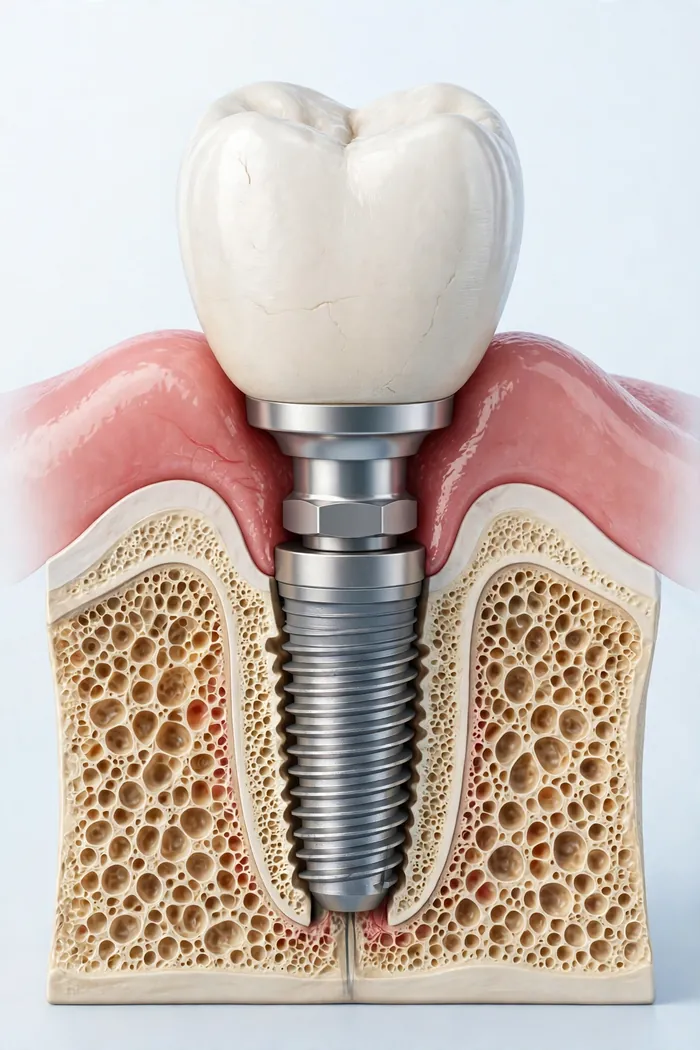
This is the most common form of partial coverage, and it confuses a lot of patients. An implant has three parts: the titanium post placed in the jawbone, the abutment that connects to it, and the crown that looks like a tooth. Some plans exclude the implant post but cover the crown at the normal major-service rate. Others cover the extraction and bone graft but not the implant itself. When you read your benefits, look at each component separately. Partial help is still help.
When Insurance Says No: Common Exclusions
Now the other side. Plenty of plans still will not pay for implants, or will pay far less than you expect. Knowing the common exclusion language helps you avoid surprises.
The missing tooth clause
This is the exclusion that catches the most people. A missing tooth clause says the plan will not cover replacement of any tooth that was already missing before your coverage started. If you lost the tooth two years ago and bought this plan last month, the implant may be excluded even though the plan “covers implants” in general. Always ask specifically whether a missing tooth clause applies to you.
Waiting periods
Many plans impose a waiting period of 6 to 12 months before major services are covered. If you just enrolled, you may need to wait before the plan pays anything toward an implant. Some employer plans waive waiting periods, so check. Planning your treatment timeline around the waiting period can save you thousands.
Cosmetic classification
A minority of plans still classify implants as cosmetic and exclude them outright. This is increasingly rare, but it persists in some budget individual plans. If your plan documents list implants under exclusions, that is usually the end of the discussion for that plan, and your energy is better spent on the alternatives section below.
Annual maximums and lifetime limits
Even generous plans cap what they pay. The standard annual maximum of $1,000 to $2,000 gets used up fast by implant treatment, especially if you also need cleanings, fillings, or treatment on other teeth in the same year. A few plans also impose a lifetime limit on implant benefits. Once you know your maximum, you can plan multi-stage treatment across calendar years to get the most from your coverage. For example, having the extraction and bone graft done in December and the implant placed in January can let you use two years of benefits.
How to Read Your Own Benefits
Plan documents are written to be confusing. Here is a practical way to find the answers that matter for implants.
Step 1: Find the summary of benefits
Log in to your insurer’s member portal and download the Summary of Benefits and Coverage. Search it for the words “implant,” “major services,” “missing tooth,” and “waiting period.” Note the coverage percentage for major services, your annual maximum, your deductible, and whether you have met any of it yet this year.
Step 2: Call and ask five specific questions
Plan documents leave gaps, so call the member services number and ask:
- Are dental implants a covered benefit under my plan?
- What percentage of major services does my plan pay?
- What is my remaining annual maximum for this year?
- Is there a waiting period or missing tooth clause that applies to me?
- Does the plan require pre-authorization for implants?
Write down the answers, the date, and the name of the representative. If a dispute arises later, this record helps. The American Dental Association also publishes plain-language explainers of common dental benefit terms if you want a second reference while you read.
Step 3: Compare plan types
Not all dental coverage works the same way. This table summarizes what to expect from the common options.
| Plan type | Implant coverage | Typical cost to you |
|---|---|---|
| PPO dental insurance | Often covers 50% of major services up to annual max | $2,000-$4,000+ out of pocket per implant |
| HMO / DHMO dental plan | Rarely covers implants; fixed copay schedule | Usually full price or plan discount only |
| Discount dental plan | Not insurance; 10-60% off at member dentists | Reduced fee, no annual max |
| Medicare (Original) | Does not cover dental implants | Full price unless Medicare Advantage helps |
| Medicare Advantage | Some plans include limited dental benefits | Varies widely by plan |
| Medicaid (adult) | Varies by state; most do not cover implants | Usually full price |
If you are comparing dentists as well as plans, our guide to the best implant dentist near you explains what to look for beyond the price tag.
Pre-Authorization: Get Approval Before Treatment Starts
If your plan covers implants, do not skip pre-authorization (also called a pre-determination of benefits). This is a formal request your dentist sends to the insurer before treatment, and the insurer replies with exactly what it will pay. Here is how it works.
- Your dentist submits the treatment plan. This includes X-rays, clinical notes, and the specific procedure codes for each step: extraction, bone graft, implant placement, abutment, and crown.
- The insurer reviews it. This usually takes 2 to 4 weeks. The insurer checks your coverage, waiting periods, missing tooth clause, and remaining annual maximum.
- You get a written estimate. The pre-authorization letter states what the plan will pay and what you will owe. This is not a final guarantee, but it is close, and it protects you from surprise bills.
- Schedule treatment. Once you have the letter, you and your dentist can plan the timeline, including whether to split treatment across calendar years.
A pre-authorization is free to request and there is no downside. Any dentist experienced with implants, like those described in our dental implants explained guide, will handle the paperwork as a routine part of the process. If a dental office discourages you from getting pre-authorization, consider that a red flag.
How to Appeal a Denial
Denials are common, and they are not always final. Insurers deny first and ask questions later, especially for expensive procedures. If your implant claim is denied, you have the right to appeal, and appeals succeed more often than people expect.
Read the denial letter carefully
The letter must state the specific reason: missing tooth clause, waiting period, cosmetic classification, or missing documentation. The reason determines your strategy. A denial for “insufficient documentation” is very different from a denial for “excluded benefit.”
Gather stronger evidence
Ask your dentist for a letter of medical necessity explaining why the implant is needed: bone loss in the jaw, shifting of neighboring teeth, difficulty chewing, or documented injury. Include X-rays, photos, and chart notes. The more clinical the evidence, the harder the denial is to defend.
File the internal appeal
Every plan has an internal appeals process, usually with a deadline of 60 to 180 days from the denial. Submit your appeal in writing, reference the denial letter, attach the new evidence, and keep copies of everything. Many states require insurers to decide internal appeals within 30 days.
Request an external review
If the internal appeal fails, you can request an independent external review through your state’s department of insurance. An outside medical reviewer looks at the case fresh, and their decision is binding on the insurer in most states. This step costs you nothing and overturns a meaningful share of denials.
No Coverage? Your Real Options
If your plan excludes implants or you have no dental insurance at all, you still have paths to affordable treatment. None of these are perfect, but each can cut the bill substantially.
Dental discount plans
These are not insurance. You pay an annual fee, typically $100 to $200, and get 10 to 60 percent off the dentist’s standard rates at participating practices. There are no annual maximums, no waiting periods, and no missing tooth clauses. For a single implant, the savings can easily exceed the membership cost. Just confirm the discount applies to implant codes before you join.
Payment plans and financing
Many implant practices offer in-house payment plans that split the cost across the months of treatment, which often spans 4 to 8 months anyway. Third-party medical financing companies offer longer terms, sometimes with promotional no-interest periods. Read the terms carefully: deferred-interest plans can backdate interest charges if you miss the payoff deadline. A health savings account (HSA) or flexible spending account (FSA) can also pay for implants with pre-tax dollars, which effectively discounts the cost by your tax rate.
Dental schools
Accredited dental schools provide implant treatment at 30 to 50 percent below private-practice prices. The work is done by advanced students or residents under close faculty supervision, and the quality standards are high. The tradeoff is time: appointments take longer and scheduling is less flexible. If cost is the main barrier, dental schools are one of the best-kept secrets in dentistry.
Phase the treatment
You do not always have to do everything at once. If money is tight, your dentist may be able to place the implant post now and add the crown months later, spreading the cost across two budget cycles or two insurance years. Ask what staging options make clinical sense for your case. Our teeth implants 101 walkthrough covers the typical timeline so you can see where natural breaks fall.
Frequently Asked Questions
Does dental insurance cover implants in 2026?
Many PPO plans cover part of implant treatment, usually 50 percent of major services up to your annual maximum. HMO plans and Original Medicare generally do not. Check your specific plan for waiting periods and missing tooth clauses.
Why did my insurance deny my implant claim?
The most common reasons are a missing tooth clause, an unmet waiting period, classification of implants as cosmetic, or missing documentation. Read the denial letter for the exact reason, then appeal with stronger clinical evidence from your dentist.
How much will insurance actually pay toward an implant?
With a typical PPO plan covering 50 percent of major services and a $1,500 annual maximum, expect $750 to $1,500 toward a single implant, depending on your remaining benefits. Multi-tooth cases often max out the annual limit quickly.
Can I get implants with no dental insurance?
Yes. Options include dental discount plans, in-house payment plans, medical financing, HSA or FSA funds, treatment at accredited dental schools, and phasing treatment across calendar years to manage cash flow.
Is a dental discount plan better than insurance for implants?
It can be, especially if you need major work. Discount plans have no annual maximums, no waiting periods, and no missing tooth clauses. Compare the discounted fee for your specific treatment against what insurance would pay after premiums and deductibles.
Should I switch dental plans to get implant coverage?
Maybe, but do the math first. Compare the new plan’s premium, waiting period, annual maximum, and implant coverage percentage against your current situation. Switching mid-treatment can complicate pre-authorizations already in progress.
The Bottom Line
Dental insurance can take a real bite out of implant costs, but it rarely covers the whole bill. The winners are patients who read their benefits before treatment starts, get pre-authorization in writing, and plan the timing around annual maximums. A thirty-minute phone call with your insurer can easily be worth a thousand dollars or more.
If coverage falls short or does not exist, do not give up on the treatment. Discount plans, financing, dental schools, and smart phasing put implants within reach for most budgets. The most expensive option is usually waiting: bone loss and shifting teeth only make future treatment more complex. Get the facts about your plan, talk honestly with your dentist about money, and make the decision with real numbers in front of you.
This article is for informational purposes only and is not medical or insurance advice. Coverage varies by plan and state. Confirm your benefits directly with your insurer and discuss treatment options with a qualified dentist.
About Rankex Solutions
Rankex Solutions works on local SEO and Google Business Profile optimization for businesses in the UAE and the US. Its background is in rank-and-rent SEO and freelance search marketing.