Dental Implants Cost: Single Tooth, Bridge, and Full Mouth Prices
Dental implants cost more than any other common tooth replacement, so it pays to know exactly what you are paying for. A single implant can run a few thousand dollars. A full mouth of implants can cost as much as a new car. The range is wide because the phrase “dental implants” covers very different treatments, from one replacement tooth to a brand new set of teeth.
This guide breaks down dental implants cost by treatment type: single tooth, implant-supported bridge, and full arch or full mouth. You will see realistic 2026 price ranges, what pushes costs up or down, the extra procedures that add to the bill, and sensible ways to pay for it all. If you want the deepest look at one-tooth pricing, read our guide to single tooth implant cost first, then come back here for bridge and full mouth numbers.
Quick answer: In 2026, a single dental implant typically costs $3,000-$6,000. An implant-supported bridge (3 units) usually runs $6,000-$12,000. A full arch (All-on-4) generally costs $15,000-$30,000 per arch, and a full mouth (both arches) often lands between $30,000-$60,000. Bone grafts, extractions, premium materials, and your location move these numbers up or down.
2026 Dental Implant Prices at a Glance
Use this table as your starting point. These are US national averages for 2026 and assume a straightforward case with no major complications.
| Treatment | Typical price range | Implants placed |
|---|---|---|
| Single tooth implant | $3,000-$6,000 | 1 |
| Implant-supported bridge (3 units) | $6,000-$12,000 | 2 |
| Implant-supported bridge (4 units) | $9,000-$18,000 | 2-3 |
| Full arch / All-on-4 (per arch) | $15,000-$30,000 | 4-6 |
| Full mouth (both arches) | $30,000-$60,000 | 8-12 |
Two things stand out from this table. First, the per-tooth cost drops as the treatment gets bigger. A single implant costs $3,000-$6,000 for one tooth. A full arch replaces 10-14 teeth on 4-6 implants, which brings the effective cost per tooth down a lot. Second, the ranges are wide on purpose. Your final quote depends on your bone, your materials, and your zip code. The rest of this guide explains why.
One more note on how quotes work. Some clinics advertise a low “starting at” price for the implant post alone. The post is only one of three parts. The abutment (the connector) and the crown (the visible tooth) add $1,000-$3,000 more. Always ask whether a quote covers all three parts plus surgery, or just the post.
Single Tooth Implant Cost: The Basics
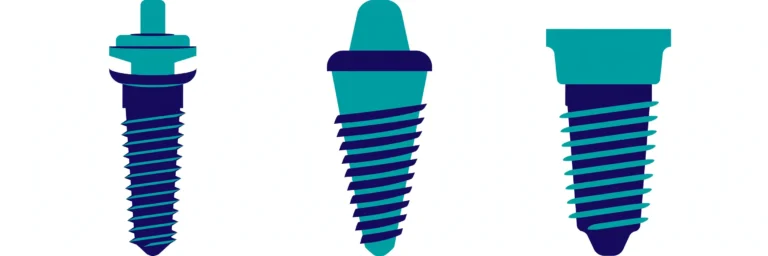
A single tooth implant has three parts: the titanium post placed in the jawbone, the abutment that connects to it, and the crown that looks like a tooth. Most US quotes in 2026 land between $3,000 and $6,000 for all three parts plus the surgery. Simple cases in lower-cost areas can come in under $3,000. Complex cases with bone grafting can pass $7,000.
We cover one-tooth pricing in full detail in our dedicated single-tooth guide, including a line-by-line quote breakdown and what to ask at the consult. The short version: if you are replacing one tooth, budget around $4,500 as a middle-of-the-road figure and get at least two quotes. To understand the procedure itself before you price shop, see how implants work.
How Much Does an Implant-Supported Bridge Cost?
An implant-supported bridge replaces several missing teeth in a row without placing an implant under every tooth. A 3-unit bridge uses two implants to support three connected crowns. It is a popular middle ground between a single implant and a full arch, and it costs less per tooth than separate single implants.
In 2026, a 3-unit implant-supported bridge typically costs $6,000-$12,000 all in. A 4-unit bridge (two or three implants supporting four crowns) usually runs $9,000-$18,000. The bridge itself is one connected piece, which keeps lab costs lower than making each tooth separately.
| Bridge size | Implants | Typical price range |
|---|---|---|
| 3-unit bridge | 2 | $6,000-$12,000 |
| 4-unit bridge | 2-3 | $9,000-$18,000 |
Bridges make the most sense when you have two or three missing teeth next to each other. If the gap is larger, or the remaining teeth are weak, your dentist may suggest individual implants or a partial denture instead. A quick way to get oriented on the options is our overview of types of teeth implants, which walks through every configuration from one tooth to a full mouth.
Full Arch and All-on-4 Cost
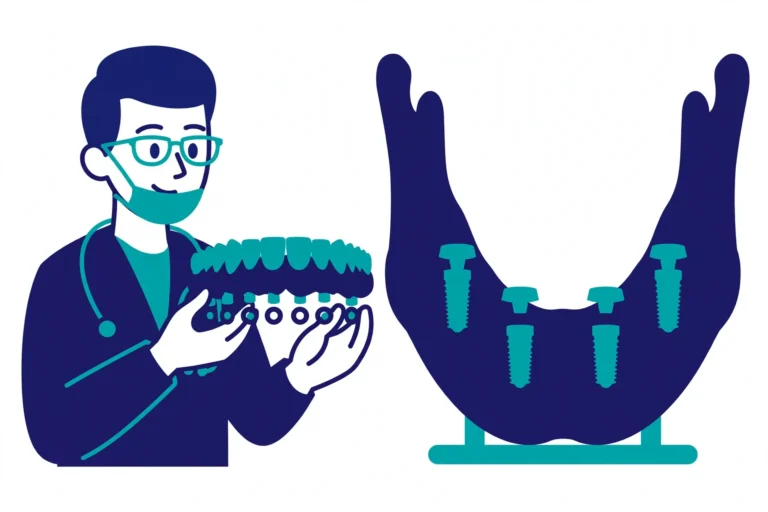
Full arch treatment replaces all the teeth in an upper or lower jaw using 4-6 implants. “All-on-4” is the best-known version: four implants support a full arch of teeth. Some cases need six implants (“All-on-6”) for extra stability, which adds to the cost.
Per arch, All-on-4 typically costs $15,000-$30,000 in the US in 2026. Both arches (a full mouth) usually land between $30,000 and $60,000. The material of the final teeth is the biggest swing factor inside that range:
| Final teeth material | Per arch, typical range | Notes |
|---|---|---|
| Acrylic / composite | $15,000-$22,000 | Lighter and more affordable; may need replacement sooner |
| Porcelain-fused | $20,000-$27,000 | Natural look and strong; mid-range price |
| Full zirconia | $25,000-$35,000 | Strongest option with the most natural look; highest price |
Many full-arch quotes include the surgery, the temporaries (teeth you wear while healing), and the final set of teeth. Some do not. Ask for an itemized quote that states exactly which visits and which teeth are included, so you are not surprised by a second bill when the finals are ready.
What Makes Dental Implants Cost More or Less
Two patients can walk into the same clinic and get quotes $5,000 apart. Here is what moves the number.
Bone grafts and tooth extractions
Implants need solid bone to grip. If you lost bone after an extraction or from gum disease, you may need a bone graft first. A simple graft adds $400-$1,200 per site. Larger grafts or sinus lifts can add $1,500-$3,000. A surgical extraction adds $200-$600 per tooth. These are the most common reasons a quote climbs above the averages in this guide.
Implant and crown materials
Most implant posts are titanium, which has decades of research behind it. Zirconia posts (metal-free) cost more and suit patients with metal sensitivities. For the visible tooth, a standard porcelain crown is the norm. Premium layered zirconia crowns look slightly more natural and cost a few hundred dollars more per tooth. On a full arch, the material choice alone can swing the total by $5,000-$10,000.
Where you live
Implant prices track local costs of living. Major coastal metros often run 20-40 percent above the national average. Smaller cities and rural areas often come in below it. This is also why dental tourism ads look tempting, a topic we address honestly in the FAQ below.
Technology and planning
Clinics that use 3D cone-beam CT scans and guided surgery plan the implant position digitally before touching the bone. This usually means faster surgery and fewer surprises. The scan itself can add $150-$400 to the bill, but it often saves money by avoiding complications. Ask whether imaging is included in your quote or billed separately.
Sedation
Local anesthesia is standard and usually included. If you want IV sedation or deeper sedation, expect $500-$1,500 extra depending on the length of the procedure. For full-arch surgery, sedation is common and often worth budgeting for.
Costs People Forget to Ask About
The implant quote is not always the whole bill. Before you sign anything, ask about each of these:
- Consultation and exam: $75-$200, sometimes free or credited toward treatment.
- 3D imaging: $150-$400 if not included in the quote.
- Temporary teeth: $300-$1,000 per arch while implants heal.
- Follow-up visits: usually included for the first year, but confirm it.
- Night guard: $300-$600, often recommended to protect implant crowns from grinding.
- Warranty terms: what happens if an implant fails in year two? Get the answer in writing.
A trustworthy clinic answers these questions without hesitation and gives you the quote in writing. If a price feels vague or changes between visits, get a second opinion before committing.
Paying for Implants: Financing and Ways to Save
Few people pay $30,000 out of pocket in one go. Here are the realistic options patients actually use:
- In-house payment plans: many implant clinics split the bill across the months of treatment, sometimes interest-free.
- Medical financing companies: third-party lenders offer 6-24 month interest-free plans or longer terms with interest. Compare the total cost, not just the monthly payment.
- FSA and HSA funds: implants are usually eligible expenses, which saves you the tax on that portion.
- Dental insurance: coverage varies a lot. Some plans pay a fixed amount toward implants, others exclude them. Our guide to dental insurance for implants explains how to read your benefits before you start.
- Dental schools: accredited university clinics offer implants at 30-50 percent below private practice prices, done by supervised residents. The trade-off is longer appointments.
- Phased treatment: replace the most urgent teeth now and plan the rest over 1-2 years. Your dentist can sequence the work so nothing already done goes to waste.
- Dental discount plans: these are membership clubs, not insurance. They can shave 10-20 percent off at participating clinics for an annual fee.
Be skeptical of ads promising full mouth implants for $7,000-$10,000. At real US lab and material costs, that price rarely covers a complete, quality treatment. It is often the “starting at” price for the posts alone, or it involves cutting corners you do not want cut. Always compare itemized quotes, not headlines.
Are Implants Worth the Price Compared to Alternatives?
Upfront, implants cost the most. Over decades, the math often flips. A traditional bridge ($2,000-$5,000) typically needs replacement every 10-15 years, and it requires shaving down the healthy teeth next to the gap. Dentures ($1,000-$3,000 per arch) need relines, replacements, and adhesives for life, and they do not stop bone loss.
Implants, by contrast, can last 20+ years and often a lifetime with good care. They also preserve the jawbone, which keeps your face shape and chewing strength. When you compare 20-year total costs instead of day-one prices, implants frequently come out ahead, especially for younger patients.
| Option | Typical upfront cost | Likely replacements in 20 years |
|---|---|---|
| Single implant | $3,000-$6,000 | 0-1 (crown only) |
| Traditional bridge | $2,000-$5,000 | 1-2 full replacements |
| Partial denture | $1,000-$2,500 | 2-3 replacements plus relines |
That said, implants are not right for everyone. Smokers, people with uncontrolled diabetes, and patients with severe bone loss face higher failure rates. A candid consult will tell you whether you are a good candidate before you spend anything.
Frequently Asked Questions
Why do dental implants cost so much?
Three things drive the price: the implant hardware itself (medical-grade titanium made to tight tolerances), the surgical skill and planning involved, and the custom crown or bridge built for your mouth. You are paying for a small surgical procedure plus a custom prosthetic, not just a product off a shelf.
Can I really get full mouth implants for $9,999 like the ads say?
Almost never at that all-in price in the US. Those ads usually show the starting price for implant posts alone, exclude the final teeth, or require you to qualify for a stripped-down package. A realistic full mouth (both arches, finished teeth) costs $30,000-$60,000. Always ask for an itemized written quote.
Does dental insurance cover implants?
Sometimes, partially. Many plans now offer an implant benefit of $1,000-$2,000 per year, while others still exclude implants entirely. Check your annual maximum too, since big cases use it up fast. See our full breakdown of dental insurance for implants to learn what to ask your insurer.
How long do dental implants last?
The implant post itself can last a lifetime. The crown or bridge on top usually lasts 15-25 years before normal wear calls for a replacement. Daily brushing, flossing, and regular checkups are what separate the 15-year crowns from the 25-year ones.
Are cheap implants abroad worth the risk?
Dental tourism can cut the bill in half, but weigh the trade-offs honestly: follow-up care happens thousands of miles away, implant brands may differ from what US dentists stock (which complicates future repairs), and legal recourse is limited if something goes wrong. If you go, choose a clinic that documents the exact implant brand and gives you the records to bring home.
Can I finance dental implants with bad credit?
It is harder but not impossible. In-house plans at the clinic are your best bet since they sometimes skip credit checks. Dental schools cost less to begin with. A phased treatment plan also spreads the cost so you borrow less, or nothing at all.
The Bottom Line
Dental implants cost $3,000-$6,000 per tooth, $6,000-$18,000 for an implant-supported bridge, and $15,000-$30,000 per arch for full-arch treatment. Bone grafts, materials, and location explain most of the variation inside those ranges. Itemized quotes from two or three clinics will tell you exactly where you stand.
If the numbers feel steep, remember you have options: phasing treatment over time, dental schools, discount plans, and financing all bring quality implants within reach. Start with a consult, get everything in writing, and never let a headline price rush your decision.
This article is for informational purposes only and is not medical advice. Implant treatment should be planned with a qualified dental professional who has examined you in person. Prices are US averages for 2026 and vary by clinic and region.
For background on the procedure itself, the American Dental Association’s MouthHealthy guide to implants is a solid starting point.
About Rankex Solutions
Rankex Solutions works on local SEO and Google Business Profile optimization for businesses in the UAE and the US. Its background is in rank-and-rent SEO and freelance search marketing.